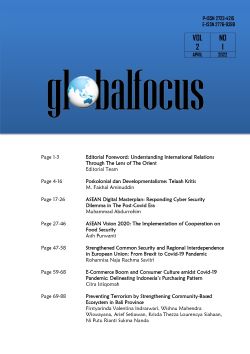
Strengthened Common Security and Regional Interdependence in European Union: From Brexit to Covid-19 Pandemic
DOI:
https://doi.org/10.21776/ub.jgf.2022.002.01.4Abstract
The results of Brexit referendum have led to a differentiation in terms of decisions and responds between leaders in the European Union about the future of this regional organization. As a result, the European Union was divided into two groups which is “more Europe” and “less Europe” as it hinders in reaching consensus regarding the formulations of a policy in the European Union. This research uses the theory of Interdependence and common security to analyze European Union’s responds to Brexit and COVID-19 where the compilation of the analysis’ results was carried out using qualitative methods and an explanatory approach. In fact, the COVID-19 Pandemic brought a negative impact in many fields that can destabilize not only member countries, but also regional security in Europe. The results of this research indicate that the European Union, which was heading towards disintegration due to Brexit, was able to set aside fragmented national interests by increasing interdependence to achieve common security in the European Union due to the COVID-19 Pandemic. This interdependence is proven by holding meetings and a common viewpoint on the threat of Covid-19, so that policy formulation can be carried out comprehensively and responsively.
References
References
Aleksovski, S., Bakreski, O. & Avramovska, M. B., 2014. Collecive Security - The Role of International Organizations - Implications in International Security Order. Mediterranean Journal of Social Sciences Vol. 5 No. 27, pp. 274-282.
Blackaby, F., 1986. 23. The Concept of Common Security. Bulletin of Peace Proposals Vol. 17 Issue 3-4, pp. 395-408.
Business Standard, 2021. Business Standard. [Online] Available at:
https://www.business-standard.com/article/international/european-union-unemploym ent-rate-rose-to-7-5-in-dec-2020-121020200714_1.html
Cambridge, 2020. Supranational. [Online]
Available at: https://dictionary.cambridge.org/dictionary/english/supranational
ECDC Europa, 2021. European Centre for Disease Prevention and Control. [Online] Available at: https://www.ecdc.europa.eu/en/covid-19/timeline-ecdc-response ECDC Europa, 2021. European Centre for Disease Prevention and Control. [Online] Available at:
https://www.ecdc.europa.eu/en/geographical-distribution-2019-ncov-cases
EIB, 2021. Building a Smart and Green Europe in the Covid-19 Era (Investment
Report 2020/2021), Luxembourg: Economics Department of European Investment Bank.
European Council, 2021. 10 things the EU is doing to fight COVID-19 and ensure recovery. [Online]
Available at:
https://www.consilium.europa.eu/en/policies/coronavirus/10-things-against-covid-19/ European Council, 2021. Meeting Calendar. [Online]
Available at: https://www.consilium.europa.eu/en/meetings/calendar/?Category=meeting&Page=1 &dateFrom=2020%2F01%2F01&dateTo=2022%2F05%2F16&filters=69020
Eurostat, 2020. Preliminary Flash Estimate for the Second Quarter of 2020,
Luxembourg City: Eurostat.
Eurostat, 2020. The 2017 results of the International Comparison Program: China, US and EU are the largest economies in the world , Brussel: Europa.eu.
Hargrave, M., 2020. Government and Policy. [Online]
Available at: https://www.investopedia.com/terms/s/supranational.asp
Hough, P., Malik, S., Moran, A. & Piilbeam, B., 2015. International Security Studies: Theory and Practice. New York: Routledge.
Keohane, R. O., 1986. Reciprocity in International Relations. International Organization, Volume 40, pp. 1-27.
Keohane, R. O., 1990. Multilateralism: An Agenda for Research. International Journal XLV, p. 737.
Kompas, 2020. Kompas. [Online] Available at:
https://nasional.kompas.com/read/2020/07/24/21284771/persentase-kematian-covid- 19-di-ri-masih-di-atas-global
Leigh, S. M., 2020. Relaunch or disintegration? What Covid-19 means for the future of Europe. [Online]
Available at:
https://blogs.lse.ac.uk/europpblog/2020/12/14/relaunch-or-disintegration-what-covid- 19-means-for-the-future-of-europe/
Luo, C.-M., 2017. Brexit and Its Implications for European Integration. European Review Vol. 25 No. 4, pp. 519-531.
Mix, D. E., 2021. The United Kingdom: Background, Brexit, and Relations with the United States. Congressional Research Service, pp. 1-24.
Moller, A. & Oliver, T., 2014. The United Kingdom and the European Union: What would a "Brexit mean for the EU and other States Around the World?. In: DGAP Analyse. Berlin: The German Council on Foreign Relations, pp. 1-124.
Mueller, B., 2021. What is Brexit? And What Happens Next?. [Online] Available at: https://www.nytimes.com/article/brexit-uk-eu-explained.html
Mwagwabi, L. W., 2010. The Theory of Collective Security and Its Limitations in Explaining Internationa Organization: A Critical Analysis. [Online]
Available at: https://papers.ssrn.com/sol3/papers.cfm?abstract_id=2948271 Nugrahani, F., 2014. Metode Penelitian Kualitatif. Surakarta: Cakra Books.
Pammasena, E. A., 2017. Kepentingan Inggris Keluar dari Keanggotaan Uni Eropa Tahun 2016. Jurnal Online Mahasiswa FISIP, Vol. 4 No. 2, pp. 1-16.
Pruitt, S., 2017. The History Behind Brexit. [Online]
Available at: https://www.history.com/news/the-history-behind-brexit
Roloff, R., 2020. Covid-19 and No One's World. Connections, Vol. 19 No. 2, pp. 25-37.
Sarwono, J., 2006. Metode Penelitian Kuantitatif dan Kualitatif. Yogyakarta: Graha Ilmu.
Shaviola, D., 2019. Multilateralisme: PBB sebagai Mediator Penyelesaian Konflik, bukan Penentu Penyelesaian Konflik. [Online]
Available at:
https://jurusanhi.com/multilateralisme-pbb-sebagai-mediator-penyelesaian-konflik-bu kan-penentu-penyelesaian-konflik/
Simajuntak, T. R. & Agussalim, D., 2014. Sikap Negara-Negara Anggota Uni Eropa dalam Menghadapi Krisis Yunani (Studi Kasus: Sikap Jerman, Perancis dan Inggris). Cakrawala Jurnal Penelitian Sosial Vol. 3 No. 2, pp. 249-268.
Stewart, C., 2021. Coronavirus (Covid-19) Cases Per 100,000 in the Past 7 Days in Europe 2021 by Country, United Kingdom: Statista.
Stewart, C., 2021. Number of New Coronavirus (Covid-19) Deaths in Europe since February 2020, United Kingdom: Statista.
Sudaryono, P. A., 2016. Alasan Inggris Keluar dari Uni Eropa pada Referendum 2016. [Online]
Available at: http://repository.umy.ac.id/bitstream/handle/123456789/7719/naskah%20publikasi.pd f?sequence=11&isAllowed=y
Verma, R., 2020. China's Diplomacy and Changing the Covid-19 Narrative. SAGE International Journal, pp. 1-11.
Vet, J. M. d. et al., 2021. Impacts of the Covid-19 Pandemic on EU Industries, Luxembourg: European Parliaments Committee on Industry, Research and Energy (ITRE).
Walker, N., 2021. Brexit Timeline: Events Leading to the UK's Exit from the European Union. House of Commons Briefing Paper No. 7960, pp. 1-86.
WHO, 2020. World Health Organization. [Online] Available at:
https://www.who.int/dg/speeches/detail/who-director-general-s-opening-remarks-at-t he-media-briefing-on-covid-19 11-march-2020
Winarno, B., 2014. Dinamika Isu-Isu Global Kontemporer. Yogyakarta: Center of Academic Publishing Service (CAPS).
World Bank, 2020. GDP (current US$) - European Union, s.l.: World Bank Data. Wunderlich, J.-U., 2021. Comparing Regional Organizations in Global Multilateral
Institutions: ASEAN, the EU, and the UN. [Online] Available at: https://core.ac.uk/download/pdf/78887193.pdf
Yuliana, 2020. Corona Virus Diseases (Covid-19): Sebuah Tinjauan Literatur.
Wellness and Healthy Magazine, Vol. 2 No. 1, pp. 187-192.
Downloads
Published
Issue
Section
License

Authors who publish with this journal agree to the following terms:
- Authors retain copyright and grant the journal the right of first publication with the work simultaneously licensed under a Creative Commons Attribution License-NonCommercial 4.0 International that allows others to share the work with an acknowledgment of the work's authorship and initial publication in this journal for non-commercial purposes.
- Authors are able to enter into separate, additional contractual arrangements for the non-exclusive distribution of the journal's published version of the work (e.g., post it to an institutional repository or publish it in a book), with an acknowledgment of its initial publication in this journal.
- Authors are permitted and encouraged to post their work online (e.g., in institutional repositories or on their website) prior to and during the submission process, as it can lead to productive exchanges, as well as earlier and greater citation of published work.