Archives
-

Vol. 5 No. 1 (2025)
The expanding influence of actors beyond the bounds of traditional state institutions increasingly characterizes the contemporary global landscape. The active participation of non-state entities has significantly reshaped the dynamics of international engagement, fostering a more complex, adaptive, and multidimensional network of global interactions. In an era of deepening interconnectivity and continuous transformation, global actors must refine and recalibrate their strategic approaches to effectively navigate the evolving international environment. In light of these developments, Journal Global Focus (JGF) Vol. 5 No. 1 is devoted exclusively to examining the diverse strategies employed by global actors operating within this intricately interdependent global system. This edition comprises six scholarly articles and one critical book review, each contributing unique insights into the field of International Relations.
-
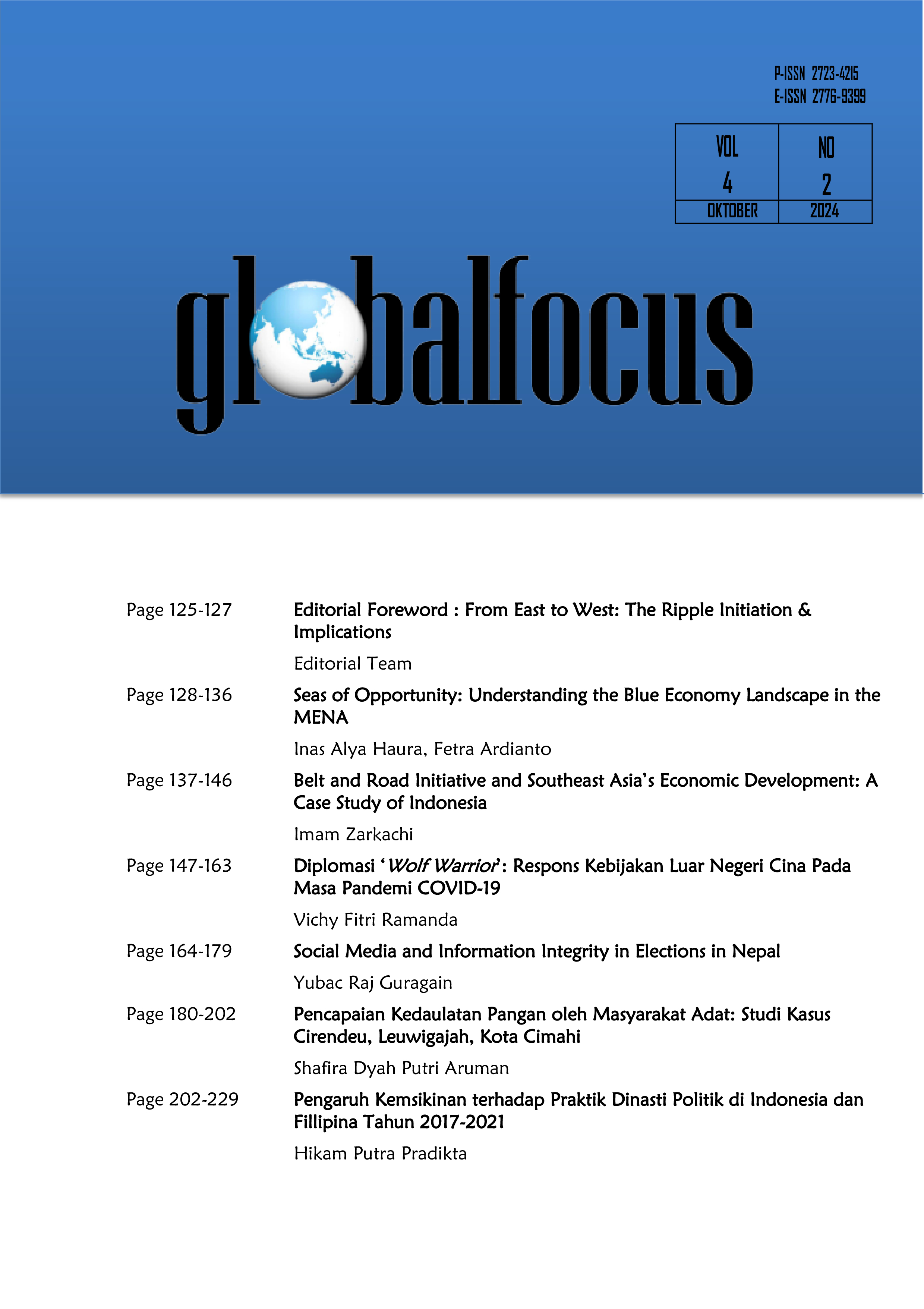
Vol. 4 No. 02 (2024)
The juxtaposition of global and local initiatives, as explored in various studies, highlights the intricate dynamics between broader geopolitical strategies and localized responses to economic and social challenges. The theme "From East to West: Global vs. Local Initiation to its Implication" prompts us to consider how global economic and political initiatives are tailored to address social welfare in diverse regions. This examination reveals that while global frameworks, such as the Belt and Road Initiative, aim to stimulate economic growth and development across multiple countries, the actual impact of these initiatives can vary significantly based on local contexts, governance structures, and societal needs. Thus, in this edition of Journal Global Focus (JGF) Vol. 4 No 2. is dedicated to explore how initiation from global to local area could impact a wider and deeper area. It sheds light on the underlying factors driving these transitions, such as political, economic, and technology, with the six articles published in this edition with different point of view and case study.
-

Vol. 4 No. 1 (2024)
"Traversing Global Action: Cooperation to Opposition" is a comprehensive examination of the dynamic shifts in international collaboration and conflict across various arenas of global governance. The journal delves into the intricate interplay between nations, international organizations, and non-state actors as they navigate the complex landscape of global politics. divergent national interests, ideological clashes, and geopolitical rivalries. Thus, in this edition of Journal Global Focus (JGF) Vol. 4 No 1. is dedicated to explore how cooperation among nations evolves into opposition and vice versa in the realm of international affairs. It sheds light on the underlying factors driving these transitions, such as shifting power dynamics, with the six articles published in this edition with different point of view and case study.
-

Vol. 3 No. 2 (2023)
Global interactions are no longer dominated by state actors, but also non-state actors. This makes global network has a more dynamic and forward-looking exploration of interactions due to interconnected and transformative world Consequently, global actors should adapt their strategies to the ever-evolving landscape of international connectivity and communications in order to achieve their interest. Therefore, in the Journal Global Focus (JGF) Vol. 3 No. 2 is dedicated to uncovering the varied cases of strategies used by global actors in an increasingly interdependent global world. The six articles published in this edition have different points of view and case studies which enlarge the perspective in understanding of how global interaction and media dynamics shape the world we live in.
-

Vol. 3 No. 1 (2023)
Relationships within the international system are multifaceted, encompassing economic, political, social, and cultural domains. Globalization promotes the establishment of international economic networks. International economic relations are the economic exchanges that take place between different countries and the global economy as a whole. The dynamics of International economic activity driven by many activities, such as trade, investment, finance, and technology. Thus, in this edition of Journal Global Focus (JGF) Vol. 3 No. 1 is dedicated to unpacking the dynamics of international economic issues. the six articles published in this edition with different point of view and case study.
-

Vol. 2 No. 2 (2022)
Exploring the new reality of International Relations studies which is currently no longer fixated on the state as the main actor who plays a significant role in the international arena. Today, non-state actors are increasingly showing their new faces. Diplomacy to security agendas is starting to be literate to the non-state actor. However, some issues are seen as secondary issues and urge to reach out. In the current era, we are also required to answer several challenges offered by this new transnationalism agenda. Thus, this edition of Journal Global Focus (JGF) Vol. 2 No. 2 is dedicated to unpacking the issues that until now are still marginalized by the structure. The six articles published in this edition deal with different transnationalism agendas within domestic and international politics. -
Vol. 2 No. 1 (2022)
International relations were formerly determined by the western consensus. Orient mostly copied western ideas and could not resist them. The ideas of postcolonialism explained that many rationalizations from the Orient are always considered pseudo-consciousness and show the reality of knowledge disparity. The idea of binary opposition makes the debate entrapped into unidirectional. The subordination of the Orient is even stronger time by time. Moreover, the reproduction of colonial discourse is even reproduced by the orient itself. Only through the agenda of emancipatory the Orient ideas will emerge and embrace the debates. In this edition of Journal Global Focus (JGF) Vol. 2 No. 1, the editorial team proposes new agenda for understanding International Relations through the lens of the Orient. Hopefully, this edition would provoke the Orient society to be more critical of the omnipresent colonialization agenda.
-

Vol. 1 No. 2 (2021)
The mainstream scholarly discourse of International Relations has had tendencies to prioritize stability and order over justice because of its state-centric approach. Yet, we see how that is no longer the case in the 21st century. The question of justice becomes increasingly prevalent as transnationalism, global poverty, climate change, and human rights violation are on the rise. The notion of justice in International Relations is not only concerned about the morality or the moral worth of the individual to be treated equally, but it also deals with who deserves what, how, and why. In these uncertain times, we are facing global inequality and injustice with grievances that need to be addressed worldwide. -

Vol. 1 No. 1 (2021)
Globalization has already given numerous challenges and changes to global politics. The authority of the state was multiplicated to the various actor and agendas. Undoubtedly, transnational issues are rising into the field of international relations studies. Each article contributes to international relations studies debate, whether the state is still the only and the primary actor or already disaggregated.