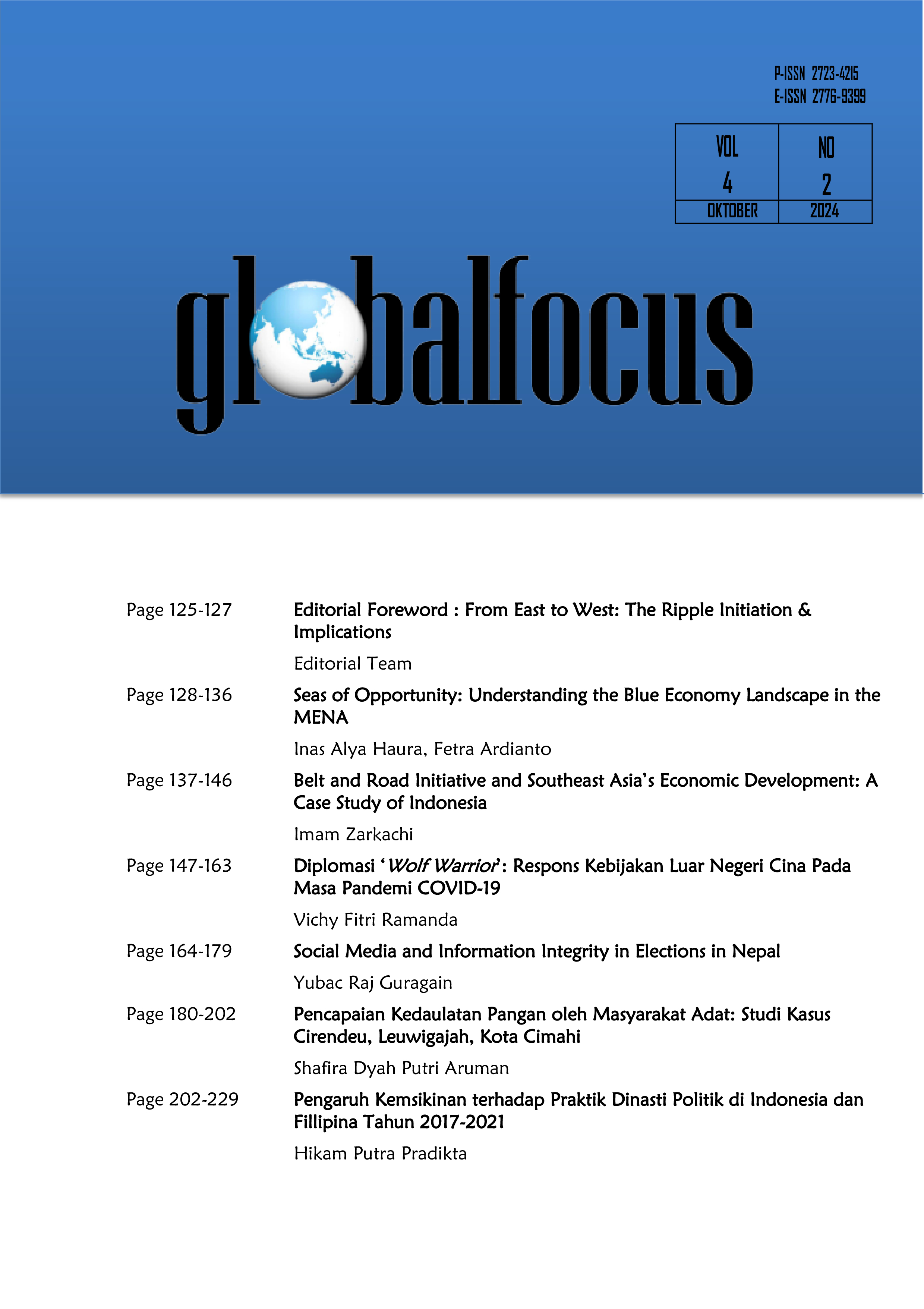
Seas Opportunity: Understanding The Blue Economy Landscape In The MENA Region
DOI:
https://doi.org/10.21776/ub.jgf.2024.004.02.1Abstract
This paper aims to investigate the emerging blue economy landscape in the Middle East and North Africa (MENA) region. Furthermore, this paper seeks to explore various dimensions of sustainable marine resource management and initiatives undertaken by MENA countries to exploit blue economy opportunities. As the MENA region advances in developing its blue economy, this study seeks to offer comprehensive insights into marine resource utilization, sustainable development principles, and increased regional collaboration in fostering a strong blue economy framework. By analyzing current practices, this research seeks to contribute to a deeper understanding of how the MENA region can effectively integrate blue economy principles into national policies, improve marine infrastructure, and build cooperative frameworks for environmental protection and economic growth.References
Bakry, U. S. (2016). Metode penelitian hubungan internasional. Yogyakarta: Pustaka Pelajar, 14.
Benfield, J. A., & Szlemko, W. J. (2006). Internet-based data collection: Promises and realities. Journal of Research Practice, 2(2), D1.
Buzan, B., & Waever, O. (2003). Regions and powers: the structure of international security (Vol. 91). Cambridge University Press.
Farzayee, S. (2023). From State-Centric to Security Complexes: A Review of Regional Security Complex Theory in International Relations. Resolusi: Jurnal Sosial Politik, 6(2), 163-179.
Heger, M., Vashold, L., Palacios, A., Alahmadi, M., & Acerbi, M. (2022). Blue skies, blue seas: air pollution, marine plastics, and coastal erosion in the Middle East and North Africa. World Bank Publications.
Juma, T. O. (2020). Application of Regional Security Complex Theory in Electoral Management, a View of East African Region. Trends in Technical & Scientific Research, 4(2), 55-62.
Lučić, D., & Bosworth, W. (2019). Regional geology and petroleum systems of the main reservoirs and source rocks of North Africa and the Middle East. The Geology of the Arab World---An Overview, 197-289.
McKinley, E., Aller-Rojas, O., Hattam, C., Germond-Duret, C., San Martín, I. V., Hopkins, C. R., ... & Potts, T. (2019). Charting the course for a blue economy in Peru: a research agenda. Environment, Development and Sustainability, 21, 2253-2275.
Pauli, G. A. (2010). The blue economy: 10 years, 100 innovations, 100 million jobs. Paradigm publications.
Sungkawati, E. (2024). Opportunities and Challenges: Adopting “Blue-Green Economy” Terms to Achieve SDGs. Revenue Journal: Management and Entrepreneurship, 2(1), 01-13.
Downloads
Published
Issue
Section
License
Copyright (c) 2024 Inas Alya Haura & Fetra Ardianto

This work is licensed under a Creative Commons Attribution-NonCommercial 4.0 International License.

Authors who publish with this journal agree to the following terms:
- Authors retain copyright and grant the journal the right of first publication with the work simultaneously licensed under a Creative Commons Attribution License-NonCommercial 4.0 International that allows others to share the work with an acknowledgment of the work's authorship and initial publication in this journal for non-commercial purposes.
- Authors are able to enter into separate, additional contractual arrangements for the non-exclusive distribution of the journal's published version of the work (e.g., post it to an institutional repository or publish it in a book), with an acknowledgment of its initial publication in this journal.
- Authors are permitted and encouraged to post their work online (e.g., in institutional repositories or on their website) prior to and during the submission process, as it can lead to productive exchanges, as well as earlier and greater citation of published work.